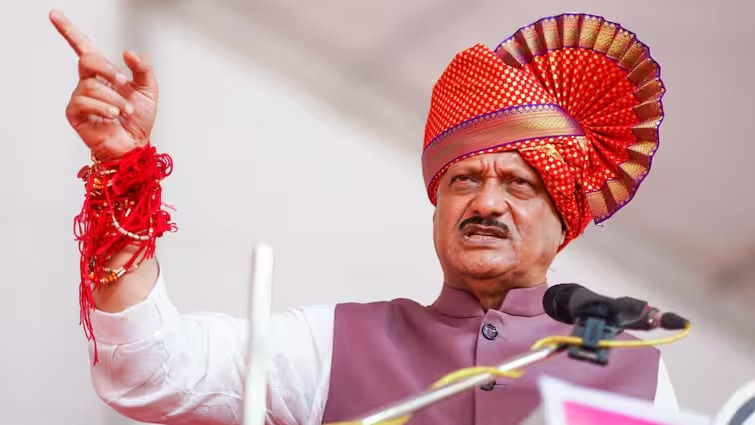
Mumbai: The sudden death of Maharashtra Deputy Chief Minister Ajit Pawar in a tragic plane crash has sent shockwaves through the state and national political landscape. The accident occurred during landing at Baramati airport, when the aircraft crashed, killing all five people on board. Ajit Pawar’s demise marks the end of an era in Maharashtra politics and opens a new chapter of uncertainty in the state’s already complex political equations.
Ajit Pawar, who famously remarked, “If it is not written in destiny, what can I do?”, took oath as Deputy Chief Minister six times—an unmatched record that reflected both his political resilience and the volatility of Maharashtra politics. Born on July 22, 1959, in Devlali Pravara of Ahmednagar district, Ajit Pawar belonged to the influential Pawar family. He was the son of Anantrao Pawar, elder brother of veteran leader Sharad Pawar. His early life was rooted in cooperative institutions, agriculture, and disciplined education, which later shaped his political style.
Educated at Maharashtra Education Society High School in Baramati and a graduate from Shivaji University, Kolhapur, Ajit Pawar entered public life at a young age. He began his political journey in 1982 through the cooperative sector and later served as Chairman of the Pune District Cooperative Bank for 16 years. In 1991, he was elected to Parliament from Baramati but vacated the seat for Sharad Pawar, who went on to become Defence Minister in the Narasimha Rao government.
Ajit Pawar made his mark in state politics as a five-time MLA from Baramati and served as Cabinet Minister for Irrigation from 1999 to 2009 under the Vilasrao Deshmukh government. Known for his blunt and straightforward style, he was often seen as a contrast to Sharad Pawar’s measured and strategic political approach. While Sharad Pawar was known for ambiguity and consensus-building, Ajit Pawar was direct, assertive, and unafraid of controversy.
The turning point in his political journey came with internal family and party dynamics. With the entry of Supriya Sule into active politics, speculation grew about succession within the Nationalist Congress Party (NCP). Over time, this rivalry reshaped the party’s internal balance. The dramatic events of November 2019, when Ajit Pawar briefly aligned with the BJP and took oath as Deputy CM alongside Devendra Fadnavis, remain one of the most stunning political developments in recent Maharashtra history. The government collapsed within 80 hours, and Ajit Pawar returned to the NCP following persuasion from family, particularly Supriya Sule.
In later years, Ajit Pawar again broke away, eventually gaining control of the NCP name and symbol in 2023. By 2024, he had firmly established himself as a key power centre in Maharashtra, serving as Deputy Chief Minister alongside Devendra Fadnavis. However, his political journey was also marked by controversies, including allegations related to irrigation projects and cooperative institutions. Though he consistently denied wrongdoing, these issues remained part of the public discourse around him.

Ajit Pawar’s personal life reflected deep family ties despite political rifts. Married to Sunetra Pawar, sister of former minister Padamsinh Patil, he had two sons, Jay and Parth Pawar. His decision to field his wife against Supriya Sule in the 2024 Lok Sabha elections later became a source of regret, as he publicly admitted it was a mistake.
His untimely death once again brings into focus the long list of Indian political leaders who lost their lives in air accidents, including Sanjay Gandhi, Y.S. Rajasekhara Reddy, Dorjee Khandu, General Bipin Rawat, and others. Such incidents leave behind not only personal loss but also political vacuums that are difficult to fill.
With Ajit Pawar’s passing, Maharashtra politics stands at a crossroads. His absence will significantly impact the power balance within the ruling alliance, the future of the NCP faction he led, and the broader state political narrative. While politics will inevitably move on, the void left by Ajit Pawar—his decisiveness, mass appeal in western Maharashtra, and role as a key strategist—will be deeply felt.
In the end, Ajit Pawar’s life reflects the paradox of Indian politics: relentless ambition, shifting loyalties, family legacies, controversies, and enduring influence. His death is not just the loss of an individual leader, but a moment that will reshape Maharashtra’s political dynamics for years to come.